
How to Choose a Backend Architecture for Your Startup
Pick the boring option. Your future self will thank you.
 By Zetflix Product Team12 min readUpdated 2026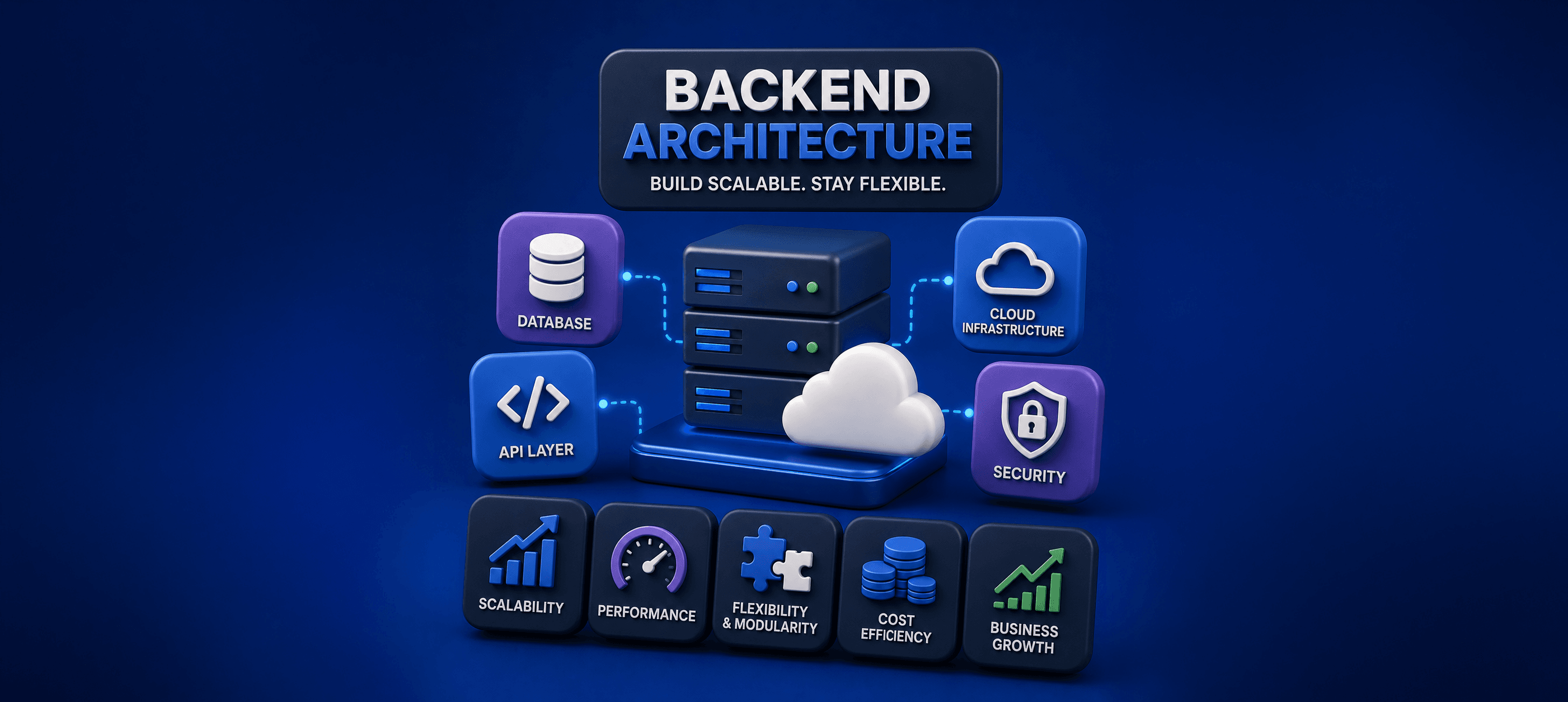
Introduction
When founders think about backend architecture, it's easy to assume it's something only developers need to worry about. But the decisions made early on affect much more than the code. They influence how quickly your team can ship new features, how much you'll spend on infrastructure, and how easily your product can grow.
The good news? For most startups, the smartest choice is also the simplest one.
Architecture Is a Business Decision
In the early stages, every decision should help you move faster, not make your product more complicated.
It's tempting to build for the future. You imagine thousands of users, multiple teams, and a product serving customers around the world. So you choose an architecture that seems ready for all of it.
The problem is that you're solving tomorrow's challenges before you've solved today's.
Your first goal isn't supporting millions of users. It's finding product-market fit.
Choosing the Right Database
Founders often assume they need the newest database technology, but that's rarely the case.
For most products, a reliable relational database like PostgreSQL does everything you need and usually much more. It's proven, flexible, and capable of handling far more traffic than most startups will ever see.
Choosing an unfamiliar or highly specialized database too early often creates more problems than it solves.
Sometimes the most reliable technology is also the smartest business decision!
Building your backend foundation?
We design architectures that ship fast today and scale cleanly later.
Build, Buy, or Borrow?
Not every feature needs to be built from scratch.
Authentication, payments, email, file storage, analytics - there are excellent services that already solve these problems.
Every week your developers spend rebuilding something that already exists is a week they're not improving the product customers actually care about.
Your engineering team's time is one of your most valuable resources. Spend it on what makes your business different.
Design for the Stage You're In
One of the biggest mistakes startups make is preparing for a level of scale they haven't reached yet.
Complex infrastructure can feel impressive, but it also takes longer to build, costs more to maintain, and slows down development when speed matters most.
Instead of designing for millions of users, design for your next milestone. Modern cloud platforms make it easy to scale when the time comes, so there's little benefit in carrying extra complexity from day one.
Keep your architecture simple enough that growth feels like an upgrade, not a complete rebuild.
The Stack We Reach for First
If we were building a startup from scratch today, we'd keep things simple: a clean monolithic backend, PostgreSQL as the database, trusted third-party services for common functionality, and a cloud platform that grows with the product.
It may not be the most exciting stack and that's exactly why it works.
The best architecture isn't the one with the most technologies. It's the one that lets your team focus on building a great product instead of managing unnecessary complexity.
Sometimes, the "boring" choice is the one that helps your startup move the fastest.
Articles you might like


Ready to Launch Your MVP?
Stop reading and start building. Our team is ready to turn your vision into a viable product.