
When to Integrate AI Into Your Product (and When Not To)
AI should solve a real problem, not be something you add just to keep up with the trend.
 By Zetflix Product Team12 min readUpdated 2026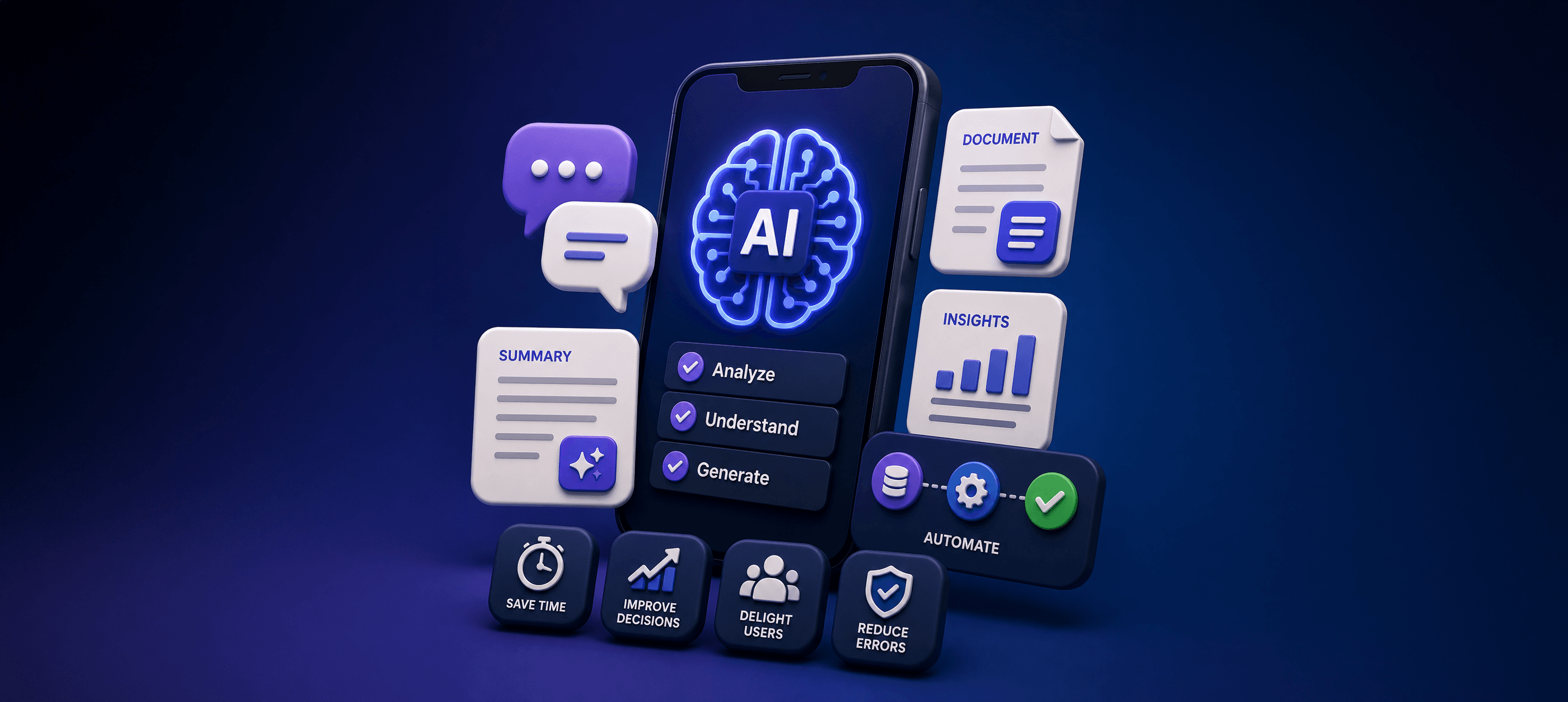
Introduction
A few years ago, simply saying your product used AI was enough to get people's attention. Today, it's almost expected. Investors have seen it countless times, and users have become much harder to impress.
The truth is, nobody downloads an app because it has AI. They download it because it helps them solve a problem.
That's why the best AI features often go unnoticed. Users don't stop and think, "Wow, this is AI." They simply think, "That was easy."
The "We Need AI" Trap
Many founders reach a point where they ask the same question: "Should we add AI?"
But that's often the wrong place to start.
A better question is: "What are our users struggling with today?"
If AI can remove friction, save time, or simplify something that feels difficult, then it's worth exploring. If it's only there because competitors have it, it's probably adding more complexity than value.
When AI Really Makes Sense
AI shines when it helps people do things that would normally take much longer.
It can summarise long documents in seconds, generate a first draft instead of starting from a blank page, organise large amounts of information, analyse images, or personalise content based on each user's needs.
In these situations, AI isn't replacing the product, it's making the experience faster, smoother, and more helpful.
That's where users begin to see real value
Thinking about adding AI to your product?
Let's pressure-test the idea before you spend a dollar building it.
When AI Is the Wrong Tool
AI is the wrong choice when accuracy must be perfect and a wrong answer is costly, when a simple rule or lookup would do the job more cheaply and reliably, or when the feature adds latency and cost without saving the user real effort. It's also wrong when it introduces a confusing layer of unpredictability into a flow that users expect to be precise.
Bolting a chatbot onto a product that didn't need one is the most common version of this mistake. Users rarely asked for it, and it often replaces a faster, clearer interface with a slower guessing game.
Thinking about adding AI to your product?
Let's pressure-test the idea before you spend a dollar building it.
When Simpler Is Better
Not every problem needs artificial intelligence.
Sometimes a search bar, a filter, or a few well-written rules will solve the problem just as effectively and with far less cost.
We've also seen products add AI chatbots simply because they felt they should. In many cases, users end up clicking through several AI responses just to find information that used to be one tap away.
When AI makes an experience slower or more confusing, it's solving the wrong problem.
How to Add AI Without Breaking Trust
The most successful AI features don't try to replace the user - they work alongside them.
Instead of making decisions for people, they offer suggestions. Instead of hiding uncertainty, they explain it. And when something goes wrong, they make it easy for users to step in and take control.
That's how trust is built. Because once users lose confidence in an AI feature, it's incredibly difficult to earn it back.
Start Small and Let Users Guide You
You don't need to reinvent your entire product with AI overnight.
Start with one feature that solves one real problem. Watch how people use it. Listen to their feedback. Measure whether it actually improves the experience.
If it does, build on that success. If it doesn't, you've learned something valuable without investing months into the wrong direction.
The companies building the best AI products today aren't the ones adding AI everywhere. They're the ones adding it thoughtfully - one useful feature at a time, always with the user at the centre of every decision.
Articles you might like


Ready to Launch Your MVP?
Stop reading and start building. Our team is ready to turn your vision into a viable product.